
Knowledge moves both ways
Knowledge transfer is a core goal of TEMPEST—and part of how the Center conducts research, educates people, and builds lasting capability.
Transfer begins by aligning goals
TEMPEST works with partners to connect the Center’s research and education mission to the questions, evidence, capabilities, and constraints that matter in each partner environment.
Education is part of the exchange
Students and postdoctoral researchers develop deep expertise while also learning to communicate across experiments, mathematics, computation, AI/ML, application science, and institutional cultures.
Activities sustain the relationship
Workshops, internships, co-ops, long-term visits, shared mentoring, working groups, and team retreats keep knowledge moving throughout the research cycle.
TEMPEST is always seeking new partners
Partnerships can begin with a shared scientific question, benchmark, dataset, experiment, software need, internship, co-op, working group, or opportunity to test a Center capability in a new setting.
Write to
Andrew Christlieb
christli@msu.edu
Copying
Michael Murillo, TEMPEST Director
murillom@msu.edu
Subject
TEMPEST Knowledge Transfer Partnership
Our role
TEMPEST’s three primary bidirectional pathways are university–university, university–national laboratory, and university–industry. Center workshops, retreats, and shared networks may also help national laboratories and industry discover useful connections, but TEMPEST does not replace or claim ownership of their direct laboratory–industry relationships.
3 primary directional pathways
TEMPEST’s university network is designed to make disciplinary depth more powerful by connecting it to complementary expertise. Knowledge moves in both directions as researchers and trainees learn how another field frames questions, produces evidence, and judges whether a model is useful.
The triple-closure problem cannot be addressed within one department or discipline. Particle and plasma physics, fluid dynamics, turbulence, applied mathematics, experiments, scientific computing, AI/ML, uncertainty quantification, astrophysics, and engineering each describe a different part of the causal chain. University-to-university knowledge transfer gives those communities a shared working language and creates teams that can follow a scientific question from a microscopic mechanism to a measurable application outcome.
TEMPEST will use common research questions rather than parallel work plans as the organizing unit. A team may begin with an experimental observation, identify the particle-scale or continuum information a model is missing, develop a structure-preserving representation, test it in high-resolution computation, and determine whether it changes a prediction in fusion energy, supernovae, or hypersonics. That process transfers questions, methods, assumptions, data, and standards of evidence—not only finished results.
What moves in both directions
- Across the university network: Deep disciplinary expertise, specialized experiments, theory and algorithms, courses and mentoring, research software, and long-horizon method development.
- Back to every participating team: New questions, shared benchmarks, cross-trained students, reusable methods, broader validation, and connections to applications outside a team’s original domain.
How TEMPEST will make the pathway active
- Cross-disciplinary workshops: Focused workshops will bring researchers and trainees together around a defined closure, measurement, modeling, or application question. Participants will leave with shared definitions, testable hypotheses, and clear next steps.
- Cross-institution research teams: Projects will deliberately combine complementary expertise and use joint milestones, shared data, common software interfaces, and regular working meetings to keep the pieces connected.
- Student and postdoctoral visits: Short rotations and longer visits will place trainees inside another university group or experimental facility so they can learn its methods, tools, and standards through direct participation.
- Shared mentoring and cross-training: Students and postdoctoral researchers will have access to mentors outside their home discipline. Short courses, tutorials, reading groups, and hands-on modules will help them build the vocabulary needed to work across fields.
- Team retreats and synthesis sessions: Center retreats will create time to compare assumptions, reconcile terminology, identify gaps between projects, and decide which ideas are ready for a common benchmark or cross-application test.
- Open research products: Where appropriate, teams will produce shared datasets, benchmark definitions, documented code, tutorials, white papers, and publications that allow knowledge to move beyond the original collaboration.
What the pathway supports
- Education mission: Knowledge transfer is part of the educational process. A TEMPEST trainee should be able to explain a scientific question to an experimentalist, mathematician, computational scientist, AI/ML researcher, and application expert—and understand what evidence each person needs. Cross-training does not replace disciplinary depth; it teaches students how to connect that depth to the rest of the Center.
- Research mission: The research benefit is faster, more reliable connection across scales. When teams share variables, uncertainty descriptions, data formats, software expectations, and validation criteria early, a closure developed at one scale is more likely to remain physically meaningful and usable at the next.
Examples of progress
- Co-advised students and dissertations
- Joint publications and proposals
- Shared benchmarks, data, and software
- Methods transferred between disciplines
- New cross-application research questions
University–national laboratory exchange connects the Center’s long-horizon research and training mission with mission-driven multiphysics, major facilities, high-performance computing, mature software, and rigorous verification and validation practice.
This pathway begins by aligning goals. Laboratory partners bring consequential scientific questions, established workflows, validation experience, data, facilities, and an understanding of where uncertainty limits a mission-relevant prediction. University teams bring new theory, mathematical structure, experimental ideas, algorithms, scientific machine learning, and the time and educational environment needed to explore methods whose value may develop over several years.
The exchange is bidirectional throughout the project. Laboratory scientists help define useful benchmarks, interfaces, evidence, and performance requirements before a method is finished. University researchers and trainees return tested models, documented algorithms, uncertainty information, and new physical understanding. Together, the teams determine whether an advance is credible and practical enough to enter a larger scientific workflow.
What moves in both directions
- Universities contribute: Fundamental theory, exploratory computation, new diagnostics and experiments, structure-preserving methods, students and postdoctoral researchers, and long-horizon development.
- National laboratories contribute: Mission questions, large-scale computation, national facilities, high-energy-density and plasma expertise, mature codes, validation practice, multidisciplinary teams, and operational constraints.
How TEMPEST will make the pathway active
- Student internships: Students will work in laboratory teams on Center-aligned problems, gaining direct experience with mission questions, large-scale workflows, verification and validation, and collaborative scientific software.
- Extended and embedded visits: Faculty, students, and postdoctoral researchers may spend longer periods working with a laboratory group when sustained engagement is needed to understand a code, facility, dataset, or scientific workflow.
- Postdoctoral exchanges and co-mentoring: Joint mentoring and exchange opportunities will connect early-career researchers to both university and laboratory expectations and help build durable relationships across institutions.
- Joint benchmarks and validation campaigns: Teams will co-design reference problems, comparison quantities, uncertainty descriptions, and evidence thresholds that allow a new closure or algorithm to be judged in progressively more demanding settings.
- Workshops and partner roundtables: Focused workshops and recurring roundtables will identify shared research topics, compare current capabilities, review progress, and adjust the collaboration when partner needs or scientific evidence change.
- Software and data exchange: Where agreements permit, teams will connect documented software components, shared repositories, curated datasets, reproducible workflows, and training materials so that an advance can be evaluated and reused.
What the pathway supports
- Education mission: Internships, long-term visits, and co-mentoring make laboratory knowledge part of a student’s education. Trainees learn how fundamental ideas are evaluated inside large multiphysics programs, how uncertainty and validation affect use, how teams maintain scientific software, and how to communicate across research, engineering, and mission contexts.
- Research mission: For TEMPEST, the laboratory connection is a demanding test of transfer. A model must preserve the right physics, remain stable and scalable, expose its uncertainty, and improve a meaningful quantity when it is placed inside a larger calculation. Laboratory feedback also returns new basic-science questions to the university teams.
Examples of progress
- PhD internships and extended visits
- Postdoctoral exchanges and joint mentoring
- Joint benchmarks and validation evidence
- Transferable software and data products
- New research questions informed by mission needs
University–industry exchange connects TEMPEST’s fundamental research to application requirements, engineering constraints, rapid design cycles, and the practical question of whether new scientific understanding improves a real decision.
Industry partners help the Center identify which uncertainties, missing physics, or computational limits matter most to a design or experimental program. Their perspective clarifies the quantities a predictive model must deliver, the fidelity and turnaround time that are useful, the evidence needed for confidence, and the constraints that determine whether a method can be adopted.
University teams contribute theory, experiments, advanced algorithms, scientific machine learning, validation methods, and a pipeline of students and postdoctoral researchers. TEMPEST’s role is to co-design fundamental questions with line of sight to use—not to replace a company’s engineering process. The strongest projects produce both new science and a clear path for evaluating whether that science changes an application-relevant outcome.
What moves in both directions
- Universities contribute: Fundamental explanations, experimental and computational methods, structure-preserving models, independent analysis, long-horizon exploration, and a cross-trained workforce.
- Industry contributes: Application requirements, engineering constraints, decision timelines, system context, validation opportunities, design feedback, and experience turning scientific capability into practice.
How TEMPEST will make the pathway active
- Challenge-definition workshops: Center and industry teams will translate an application need into a researchable question with a measurable outcome, a defined missing influence, appropriate evidence, and a realistic path to evaluation.
- Student internships and co-ops: Internships and longer co-op experiences will place students in industry settings where they can connect research methods to design decisions, teamwork, schedules, intellectual property, and professional communication.
Extended technical exchanges: Longer visits by students, postdoctoral researchers, faculty, or industry scientists will support projects that require sustained access to specialized workflows, data, experiments, or design context. - Joint research and review cycles: Partner teams will review assumptions, intermediate results, uncertainty, performance, and usability throughout a project rather than waiting for a completed method to be handed over.
- Benchmarks, software, and training: Where agreements allow, projects may produce precompetitive benchmarks, documented software components, tutorials, datasets, uncertainty reports, or training modules that can be evaluated and reused.
- Retreats and partner engagement: Center retreats and partner sessions will bring industry perspectives into broader TEMPEST discussions and help researchers see where a method developed for one application may transfer to another.
What the pathway supports
- Education mission: Internships and co-ops are educational experiences, not simply placements. Students learn to ask what decision a model supports, explain assumptions to colleagues with different expertise, work within engineering and data constraints, document results for reuse, and recognize when uncertainty makes a prediction unsuitable for action.
- Research mission: Industry engagement keeps the Center’s basic science connected to consequential questions. Partner feedback can reveal which closure error changes a design, where a faster model is scientifically adequate, what evidence is missing, and whether a transferable method survives outside the conditions in which it was developed.
Examples of progress
- Student internships and co-op experiences
- Partner-defined research questions
- Validated methods with a line of sight to use
- Documented software, benchmarks, and training
- Workforce pathways into science and engineering
Education K-12
The same turbulence that stirs cream into coffee governs how a fusion reactor confines its fuel and how a supernova mixes as it forges the elements. TEMPEST studies these flows where magnetic fields, radiation, chemical reactions, and kinetic effects collide, and they exceed any single discipline.
Training those researchers starts long before graduate school. Every level of the program, from K-12 classrooms to graduate training, will work with data drawn from real TEMPEST research; courses will be created once and shared across the partner universities; and graduate students will train with the national laboratories and industry partners.
The programs
Three levels, one pipeline
Each program feeds the next, and each works with data drawn from research happening inside the Center.
K-12: computing and data science
TEMPEST micro-courses will carry our research into K-12 classrooms as short stand-alone modules.
Undergraduate: inside real research
Undergraduate research internships will embed students directly in TEMPEST research.
Graduate: educated by the whole center
Graduate education in TEMPEST is built on integration across the partner universities.
K–12: computing and data science
TEMPEST micro-courses will carry our research into K–12 classrooms as short stand-alone modules that educators deploy, from in-class learning activities that fit within existing curriculum to after-school clubs and summer programs. Students will analyze simplified datasets from actual TEMPEST research and work their way from unplugged activities to real code, with no technical background required to start.
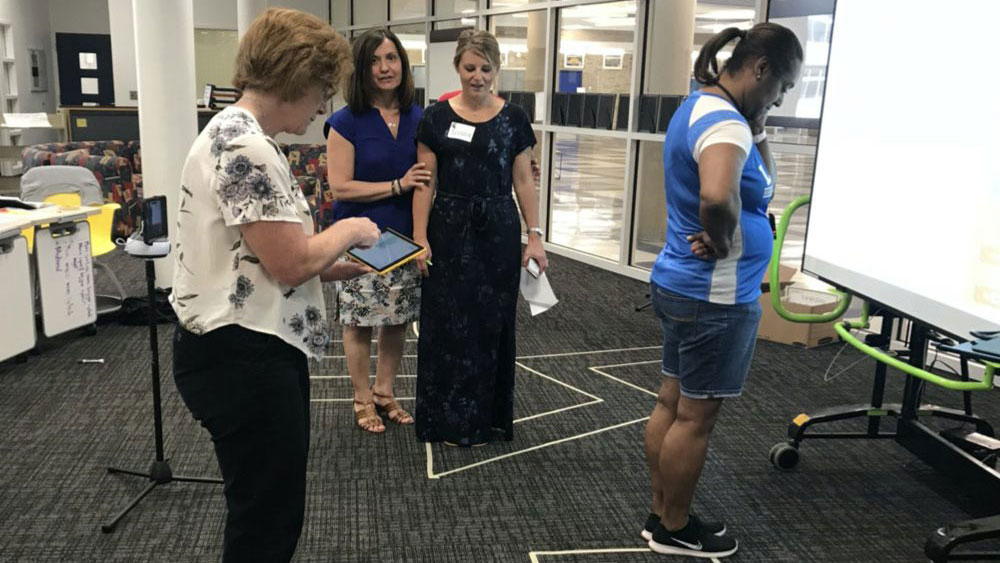
Each module ships with a complete educator toolkit, and teachers will be trained through hands-on, practice-oriented workshops: multi-day summer institutes at TEMPEST hubs, live virtual sessions during the academic year, and self-paced materials.
Undergraduate: inside real research
Undergraduate research internships will embed students directly in TEMPEST research, where they contribute to ongoing work through guided analysis and model validation on authentic center datasets.
For the broader student population, a new course — Scientific Computing Literacy in the Age of AI — will open scientific computing and machine learning to every major: how models, simulations, and data shape scientific understanding, how AI can support discovery, and the ethical and societal implications of computing in science. The course will be taught through TEMPEST datasets that span scales from laboratory flows to astrophysics.
Graduate: educated by the whole center
Graduate education in TEMPEST is built on integration across the partner universities. The institutions already teach some twenty courses directly in our research themes, in turbulence, plasma physics, AI/ML, and numerical methods.
We will add more than ten new courses to fill the gaps, among them a cross-center course, FAIR (findable, accessible, interoperable, reusable) Data and Open Science for Engineering and Physical Sciences, teaching the open research practice every trainee will use. The courses will be shared: created once and taught at partner institutions by local faculty as instructors of record, with cross-registration and live broadcast extending access.
Training across the Center
Beyond the universities
The same integration reaches out to the national laboratories and industry.
- Students will have both an internal and an external advisor. Their committees will include members from different disciplines.
- One-month rotations will send students to partner campuses to learn skills unavailable at home.
- Summer internships will be at places such as Los Alamos, Lawrence Livermore, and industry partners such as Pacific Fusion.
- An annual week-long professional development camp and biannual research retreats will bring students from across the center together for grant writing, presentations, and hands-on collaboration.
- Students will contribute their datasets and codes to the open MSU Turbulence Library.
- The approach builds on an NSF Research Traineeship at Michigan State, now in its third cohort; the generative AI training piloted there will be scaled to all trainees through workshops and recorded sessions.
The pathway
What a graduate student's six years look like
Graduate students move through a connected training experience spanning partner universities, national laboratories, and industry, with cross-disciplinary advising, professional development, and open-science practices integrated throughout.
1
Home campus
- Courses and research in TEMPEST themes
- Internal advisor and cross-disciplinary committee
2
Partner campus rotation
- One-month rotation at a TEMPEST partner
- Methods and skills not available at home
3
Center-wide training
- Professional development camp, annually
- Research retreats, twice a year
- Grant writing, presentations, teamwork
4
National lab / industry
- Summer internships at national labs such as LANL and LLNL, and industry partners such as Pacific Fusion
- External advisor and new perspectives
5
Open science practice
- Make datasets and codes FAIR and reusable
- Training in FAIR data and open science
6
Contribute to the community
- Publish data and code to the MSU Turbulence Library
- Advance TEMPEST research and the next generation of scientists
Get involved
Teachers, students, and instructors: to bring TEMPEST modules, courses, or research experiences to your classroom, email Aman Yadav at ayadav@msu.edu.